Hello everyone! Today’s post is going to be a very important one! I know for certain that someone reading this has likely had questions about high blood pressure at some point in their life. I have personally had to answer many questions about high blood pressure both in and out of work. This is a condition that plagues so many people, some of whom don’t even know they have high blood pressure because they are living in ignorance. Well, I’m here to be your “rude awakening”. YOU CANNOT IGNORE HIGH BLOOD PRESSURE. You may not feel the effects of high blood pressure right now, but I promise you, those effects will catch up with you at some point. I will discuss more later in the article how some of these effects show up; some of them can be quite severe. Please stick around and read about high blood pressure so that by gaining more information, you don’t have to pretend it’s not there.
What is High Blood Pressure?
High blood pressure (medically known as Hypertension) is exactly what it says – high pressure in the blood. This means the pressure that runs in your arteries (the blood vessels that carry blood away from your heart) is too high, all the time (1). It’s important to know that our blood pressure might go up occasionally, e.g., when we’re stressed or anxious; however, in high blood pressure, our blood pressure stays too high persistently.
Over one billion people worldwide live with high blood pressure, and almost 45% of the adult population contributes to this number (2). High blood pressure can affect anyone. There have been so many different factors found to contribute to the development of high blood pressure, but ultimately, unhealthy lifestyle choices are the key contributors. These include minimal exercise levels, unhealthy diets, and terrible sleep content.
Normal blood pressure should be around 120mmHg (top number) and 80mmHg (bottom number). The top and bottom numbers relate to your blood pressure at the 2 different stages of the heart pumping cycle (contracted and relaxed). Doctors diagnose high blood pressure at different levels, depending on where the values are recorded (1).
- If you have a blood pressure higher than 140mmHg (top number) or 90mmHg (bottom number) in a doctor’s appointment on more than one occasion, then you will be diagnosed with high blood pressure.
- If your blood pressure is hovering around these numbers but isn’t higher, then doctors will ask you to monitor your blood pressure yourself at home.
- At home, if your values are above 135mmHg (top) or 85mmHg (bottom), then you will be diagnosed with high blood pressure.
It is important that we catch high blood pressure because of all the long-term effects that can be associated with it. Oftentimes, people will have high blood pressure before they actually even see any symptoms, so regular monitoring is very important.
Causes of High Blood Pressure?
In our bodies, we have 3 main types of blood vessels: arteries, veins, and capillaries. For this article entry, we’re going to focus on arteries. Arteries, as mentioned above, carry blood away from the heart to the different organs in the body. Arteries are very thick and sturdy blood vessels because they carry blood at high pressures and high speeds. They are built like this because they have to be able to reach all the organs in our bodies, especially when going up to the brain. To maintain the right amount of pressure and speed in the arteries, the heart and vessels employ lots of different mechanisms. Some of the notable mechanisms are:
- The heart pumps at different speeds, dependent on how much pressure we need to maintain in the arteries
- The arteries can widen and narrow, depending on how much pressure we need to maintain
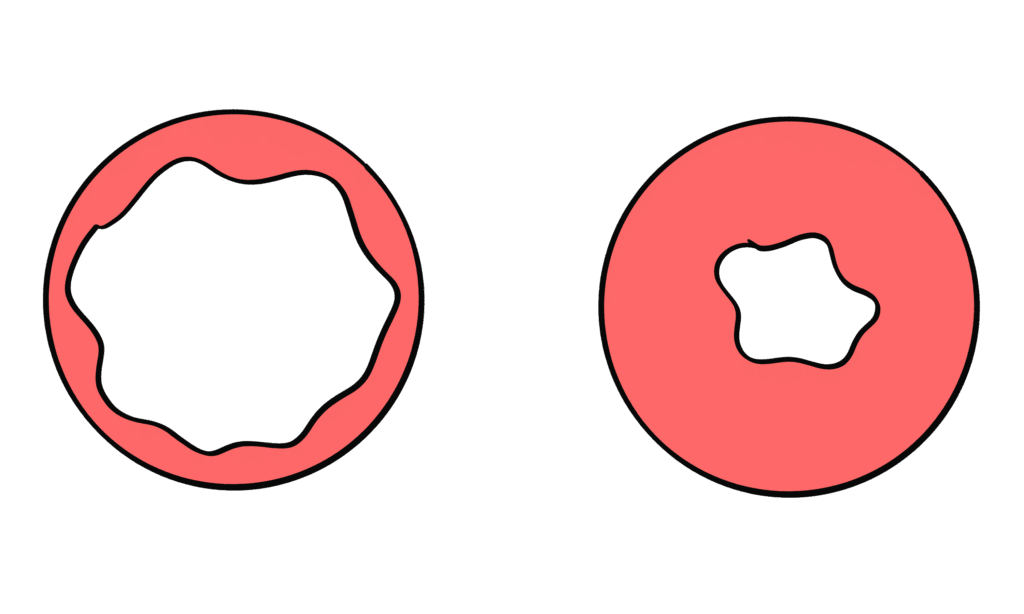
When these mechanisms are faulty, this can cause blood pressure to stay at high levels for long periods of time.
When thinking of direct causes of high blood pressure, most times, there is no cause. This is what is known as Essential Hypertension. This is a result of lots of different lifestyle factors and so therefore cannot be attributed to one particular cause. Some other forms of high blood pressure can be directly linked to other conditions that a person has. These forms of high blood pressure are known as Secondary Hypertension. This is because it is hypertension secondary to another condition. The most common conditions that can cause high blood pressure are Type 2 Diabetes Mellitus and Obesity.
Signs and Symptoms of High Blood Pressure
Most cases of high blood pressure don’t have symptoms, and they are found almost by accident. If you do have symptoms of high blood pressure, it is important that we do something about this immediately, because this might mean you already have quite severe high blood pressure, which is causing end-organ damage. This means that your blood pressure is so high that it is already causing irreversible damage to the organs in your body.
Some symptoms and signs to look out for:
- Headache
- Dizziness
- Swelling, mainly swelling in the hands and feet.
- Chest pain
- Tiredness
- Nosebleeds
- Palpitations
- Blurred vision or other vision problems
You should definitely check your blood pressure if you develop any of these symptoms over a long period of time. This should always be your first point of assessment.
I would encourage you to buy a blood pressure machine and keep an eye on your blood pressure at home using this. Check every 2-4 weeks, and keep a record of this.
Treatment
Treatment for hypertension has been studied widely, and because of this, there are so many different options for treatment that there should always be an option that works well for you. Treatment is based on so many different things:
- age
- co-morbidities (other diseases that the patient might have)
- how high their blood pressure may be
The different options for treatments are (4):
- ACE inhibitors – These are medications that work by blocking the action of some of the hormones involved in controlling blood pressure from the kidneys. (That’s right, the kidneys help with blood pressure control). By blocking these hormones, the arteries can relax and widen, as you can see in the diagram above. This reduces the pressure in the blood vessels. Some examples of this medication are Rampril, Lisinopril, Enalapril, etc.
- ARBs – these work similarly to ACE inhibitors by also working on blocking the hormone involved in the kidneys’ control of blood pressure. This is why you cannot take ACE inhibitors and ARBs at the same time. It can lead to very harmful side effects. Some examples of this are Losartan, Valsartan, Candesartan, etc.
- Calcium-channel blockers – these are medications that block the calcium channels in our artery walls. By blocking the calcium channels, we can cause the arteries to be relaxed and wider, thus reducing the blood pressure. Some examples of this are Amlodipine, Nifedipine, Felodipine, etc.
- Diuretics – these work much differently to the medications that we have already mentioned. They work by causing the kidneys to release excess fluid. By doing this, the fluid content of the body in general because much lower. This affects the blood pressure because the fluid volume in the blood is also reduced. This reduces the pressure in a different way, but still has the blood pressure-lowering effect.
There are some other groups of medications that can be used, but these are options that are offered if all the above options don’t work, so we won’t go into them today.
Complications
Now, earlier, I might’ve scared you by saying that if you don’t deal with high blood pressure early, it can cause severe problems for you later in life. If you weren’t scared by that, then let this be the thing that scares you! Below, I will be going through some of the different complications that can arise from not dealing with hypertension when it’s still controllable.
- Heart attack – this is one of the biggest complications of uncontrolled hypertension. Over time, high blood pressure causes repeated damage to the walls of our arteries, causing the artery walls to thicken from scar tissue. This also makes the arteries less elastic and stretchy. This is not good, especially when this happens to arteries in the heart. These arteries can get blocked and stop the blood from flowing to parts of the heart. This causes the heart muscle to starve and die, which causes the pain people feel in heart attacks. If parts of the heart die, the functional ability of the heart reduces, and the heart has to work harder to pump blood around your body, leading to all sorts of other problems.
- Stroke – as mentioned for heart attack, the arteries in the brain can also get blocked, or even burst, and this can cause brain tissue to die. This is really dangerous in the brain, because brain tissue doesn’t regenerate, so strokes often have irreversible effects on movement, feeling, speech, memory, and other parts of normal human function.
- Vision loss – when the blood pressure in the arteries that supply the eye is too high, this can cause many different changes to the eye’s function and vision. High blood pressure can cause new arteries to form, which can lead to higher chances of things like aneurysms (burst blood vessels) and blockages. High blood pressure in the eye can also cause swelling in the eye and in the nerve that supplies the eye, which causes blurred vision and even vision loss, because that nerve becomes damaged.
- Kidney Disease – this complication can sometimes be the cause of high blood pressure, so unfortunately, kidney disease and hypertension can be a dangerous cycle leading to serious damage to quality of life and death. The kidneys can also be damaged by high blood pressure in the same way as the heart and the brain.
There are many other complications like leg swelling and oedema, dementia, nerve dysfunction, etc, but we’ll stop at these major complications for today.
Thank you for making it to the end of this article! I hope I have successfully convinced you to go out and buy a blood pressure machine (if you wanna sound really medical, it’s called a sphygmomanometer [pronounced: sfig – mom – a – nom – meter])! And my last plea, as someone who has seen the unfortunate effect that untreated high blood pressure has on the body, CHECK YOUR BLOOD PRESSURE; and if it’s high, DO SOMETHING ABOUT IT!
References
- Oparil S, Acelajado MC, Bakris GL, Berlowitz DR, Cífková R, Dominiczak AF, Grassi G, Jordan J, Poulter NR, Rodgers A, Whelton PK. Hypertension. Nat Rev Dis Primers. 2018 Mar 22;4:18014.
- Iqbal AM, Jamal SF. Essential Hypertension [Internet]. Treasure Island (FL): StatPearls Publishing; 2025 Jan [updated 2023 Jul 20]. In: StatPearls [Bookshelf]. Available from: https://www.ncbi.nlm.nih.gov/books/NBK539859/.
- Kidwai S, Haris M, Bilal A, Saleem S, Imran H, Anwar A, Hashmi AA. High blood pressure-associated symptoms: insights from a population-based study in Pakistan. Cureus. 2024 Jul 26;16(7):e65446.
- Blood Pressure UK. Medications for high blood pressure. [Internet]. London: Blood Pressure UK; [cited 2025 Nov 3]. Available from: https://www.bloodpressureuk.org/your-blood-pressure/how-to-lower-your-blood-pressure/medications-for-high-blood-pressure/

Amazing post on high blood pressure awareness. Thanks for coming us with such a great insight. Great grace to you darling.